A response · August 2026
Digital ownership, but make it work.
A multi-faceted proposal for the post-Game Pass era. A six-month cinema window, a consumer-dictated secondhand market, physical media as the offline ledger, and a role for subscriptions in the AI games deluge.
CoverThe state of play
Game Pass failed. Sony's digital move is also wrong. Both are failing the consumer.
The subscription bet didn't reach escape velocity. Microsoft's Game Pass is losing subscribers; Sony is moving away from physical media without offering a real alternative. Gamers didn't lose faith in digital. They lost faith in the deal.
"Both of these companies are failing the consumer. They're failing the deal that they have made with us." — Gameranx, on the post-Game Pass landscape
"Xbox's version of this is actually shittier because it does more to undermine any company that doesn't participate in Xbox Game Pass. And it did this while failing at it." — Gameranx
The fix isn't to defend physical media. The fix is to give digital the agency physical used to provide: own, sell, lend, keep the value.
Why it failed
The escape velocity never came.
"Game Pass is an unsustainable model that has been increasingly damaging the industry for a decade. Subsidized by Microsoft's infinite money."
— Arcane co-founder, quoted in Gameranx
"I don't think Game Pass can coexist with other models. They'll either kill everyone else or give up."
— Arcane co-founder, via Gameranx
"Netflix proved that Netflix works, not that Xbox Game Pass works. The numbers just never reached escape velocity."
— Gameranx
The lifecycle
A $70 game has four phases. Three sequential, one constant.
The 6-month cinema window protects the premium price. Then post-launch sale, long tail, and — running throughout — digital purchases. Price tiers: $70 AAA · $20–$40 AA · up to $100 marquee (GTA 6 territory).
Cinema window
M0 → M6 · 6 months
Premium price. Console-only. No PC port. The publisher sets the price — whatever the market will hold, in their tier.
Post-launch sale
M6 → M18 · 12 months
Discounted digital sales. The secondhand market opens: every copy becomes a tradeable, lendable asset with the platform taking a cut on every transfer.
Long tail
M18+ · until cutoff
Price decays. Resale and lending continue. Eventually it stops being a real source of revenue — the cutoff is real.
Digital purchases THROUGHOUT
M0 → M∞
Buy it now, anytime. The permanent lane that doesn't care about the cinema window or the long tail. Always on, always available.
The window
Treat games like cinema: exclusive first, then everything.
Keep the $70 day-one price. Hold a six-month exclusive window. Then let the copy be a real, tradeable digital asset. No third-party markets. No early PC port to piracy-prone platforms. Just a clean, cinema-style release.
Day-1 Exclusive
$70 launch. Console-only. No PC port during the window. Protects premium pricing without needing subscriber "escape velocity".
Window closes · resale opens
Each copy becomes a tradeable digital asset. The owner sets the price. The platform takes a cut on every transfer.
Long-tail market
Price decays naturally. The game still pays out: every resale and lend earns commission, forever.
The market
Consumer-dictated. Buy it now, auction, or list. Not the platform.
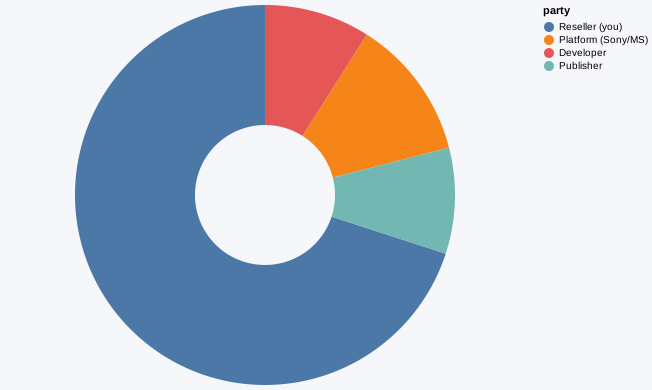
You set the rules. You set the price — fixed, auction, or best offer. The platform only takes a cut on every transfer. 30% splits across Sony, Microsoft, Steam, and Nintendo, the developer, and the publisher. Every major e-sales platform, all on the same rule.
Resale
Buy it now at your price (floor $1), auction to the highest bidder, or list with best offer. The market decides what a game is worth — not the platform. 30% commission, same rules for every major storefront.
Lending
Token transfers to a friend at no cost. Save data stays on their console. Auto-returns in a month unless they pay to keep it. Clunky by design.

Physical media solution
A hybrid disc. The game and the token stay unwritable. Updates and saves are rewritable.
Smaller physical supply, collector's editions only. The unwritable zone holds the base game and the 128-bit NFT token — you cannot rewrite ownership. The rewritable zone holds patches and saves, so the disc is always current at launch.
Physical + digitalYou can still subvert it. The subversion requires online to be impossible, physical availability to be reduced, and collector's editions to be expensive. Lend for free. Set your own resale price. There's no point abusing it.
Subscriptions
Subscriptions as an option, not the default. Indie games are still sold.
The $70 day-one price is the norm for AAA — the prestige holds. Indie games stay sold — subscription is just one channel among many. Subscriptions are the right shape for the cheap tier: <$20 retail and the coming AI-generated deluge.
AI games deluge"I do think we should keep subscriptions, but limit it to games that we're probably only going to retail for <$20 or are AI-generated."
— From the response to Gameranx
Make this work before the industry faces a seriously existential state.
Already there. So we should be considering this now, not when the worst-case has already shipped.
Premium pricing holds
Six months of exclusive access protects the $70 launch. No need for "escape velocity" the subscription model never reached.
Real ownership, real agency
Resell, lend, set your own price. The platform earns on every transfer — forever, not once. The publisher and developer earn too.
Physical still has a home
Collector's editions for the niche. Everyone else gets real ownership back. Subscriptions keep the AI / indie / cheap tier.
John Zealand-Doyle · 9 slides · in response to Gameranx · August 2026